Wednesday, March 29, 2017

(Marie) Curie(nt) Events in Nuclear Power

There is always new things happening in the world of nuclear power every day.  Some days a new innovation is created, others a disaster happens, on other days, new legislation is passed, and some days are the anniversaries for big nuclear events.  This week alone all of these different events happened.  With so much going on, it is time that we take a look at these current events.  Today, we will look at two recent events in the news; one positive, a new innovative design for nuclear power plants, and one negative, the anniversary of the Three Mile Island accidents.  To begin we will look at a new innovative nuclear power plant design.

X-Energy, an organization committed to creating cleaner energy recently released their design for a new kind of nuclear power plant called Xe-100.  According to Forbes, Xe-100 is a nuclear reactor that can be built more easily and quickly because it is made from "factory-produced components."  It's design is also resistant to meltdowns, and can shut itself down in the event of an accident (like when the plumbing or cooling isn't working).  The power plant is also relatively small as compared to normal power plants, and it can function at much higher temperatures that past plants.  These are only some of the amazing innovations, the most interesting creation by X-Energy is there fuel source to run this plant.

Dr. Kam Ghaffarian, Founder & CEO of X-Energy

The fuel source for Xe-100 is known as the pebbles.  The pebbles, as Forbes puts it, are about the size of a tennis ball.  The core of these pebbles is made up of Uranium-235.  The core is surrounded by  a layer of pyrolytic granite, which sounds fancy, but just helps all of the uranium in the core to split during fission.  Around this layer is a final layer of silicon carbide which protects the inner layers.  A bunch of the pebbles are then put together to create the core of the reactor, and as they are used up, they simply fall off, like an apple from a tree.  The pebbles are also cooled by gases, which do not absorb the contaminants from the pebbles, resulting in much less radioactive waste.  These innovations to nuclear power plants seem very promising, but it is because of past event that these ideas are created.

X-Energy Logo

This past Tuesday marked the 38th anniversary of the Three Mile Island accident.  According to VOA News, the accident occurred at 4 a.m. at the Three Mile Island Power Plant, near Harrisburg, Pennsylvania (home to the capital of Pennsylvania and a Penn State branch campus).  The accident occurred due to a plumbing failure, that did not allow the power plant to cool its reactor.  This caused the reactor to continue to overheat, which the operators did not notice at first.  Finally, after half of the reactor core had melted, the operators realized what was going on.  The nuclear power plant was then brought back under control after about sixteen hours.  People most susceptible to radiation, such as pregnant woman and children, were then advised to evacuate the area due to radiation leaks from the accident.  President Jimmy Carter even went to visit power plant to see the damage, in bring calm to the country fearing the worst from the accident.  Overall, out of this disaster came many new safety regulations, as well as people wanting to innovate to make nuclear power plants safer.  It is for this reason that many new innovations, such as Xe-100 and the pebbles were created.
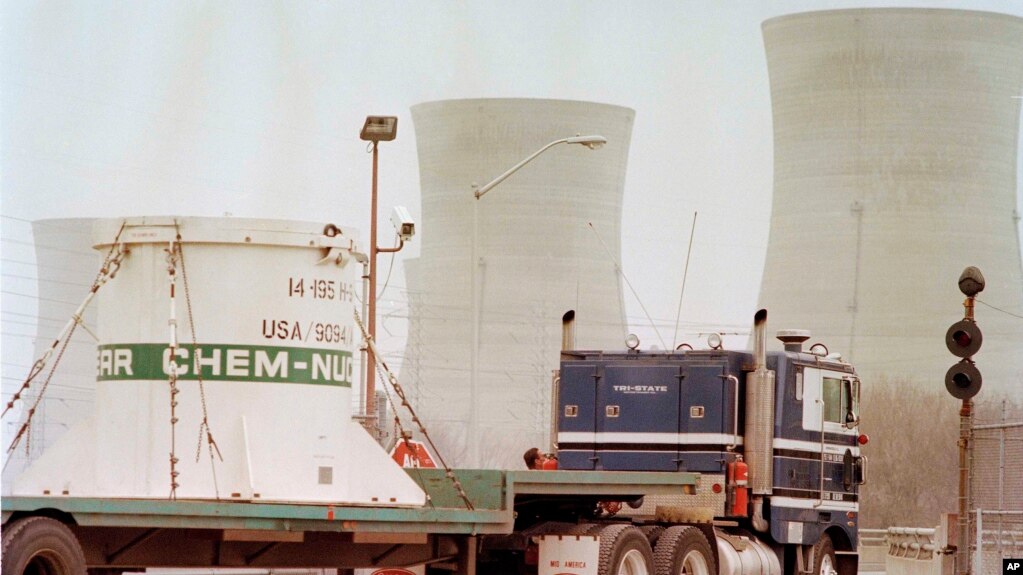
An empty containment tank enters the Three Mile Island nuclear power plant at Middletown, Penn. in March, 1979.

Three Mile Island Power Plant

The story of nuclear power is still going strong, and will most likely continue on for many years to come.  With innovations like Xe-100 being created to prevent disasters such as Three Mile Island, the current disadvantages of nuclear power may one day no longer be a problem.  Now that we have looked far and wide at all of the history, advantages, disadvantages, and current events of nuclear power, it is time to bring our learning closer to home.  In our final post, we will look at a specific nuclear power plant that is very close to all of us.  More specifically, this nuclear reactor is right on the edge of our very own campus here, at Pennsylvania State University.

Thursday, March 16, 2017

Con(tamination)s of Nuclear Power

In the last post, we looked at nuclear power from a positive light and looked at all the benefits of it.  In this post, however, we will look at the downsides of nuclear power and why it is not the best source of energy in the future and today.  So, let's begin.


The main disadvantage of nuclear energy is nuclear meltdowns.  This is a very understandable concern, because nobody likes it when things meltdown, especially nuclear plants...and ice cream.  This concern is heightened due to the Chernobyl disaster which has still left the area unlivable to this day.  According to Conserve Energy Future, even small radiation leaks can be detrimental to people's health.  Radiation can cause sickness such as nausea, fatigue, and even death.  Symptoms like this can even effect the scientists that research nuclear power, such as Marie Curie one of the most famous scientists studying radioactivity who sadly died from radiation poisoning.  Radiation leaks, although rare, can be very dangerous to people who work in nuclear plants as well as people who live near them.  Sadly, radiation is not the only dangerous thing that can come out of nuclear plants.


Another dangerous thing that comes out of nuclear reactors is nuclear waste.  Nuclear waste is very dangerous because it is another way that radiation can be released into the world.  This radiation released from nuclear waste does not turn you into a superhero, or a ninja if you're a turtle, but can cause radiation poisoning which, as we already know is very dangerous.  It is important that this nuclear waste is disposed of in a safe way so that this dangerous radiation does not occur.  However, according to Conserve Energy Future, this is a big problem with nuclear waste.  That is because it is very expensive and hard to store nuclear waste right so that it is no longer dangerous.  It also doesn't help that it can take hundreds of years for the nuclear waste to stop being dangerous.  On the flip side, one use for this nuclear waste, is to make nuclear weapons.

Nuclear weapons, although a good use for nuclear waste, are not necessarily a good thing.  Nuclear weapons are extremely dangerous and can cause extreme amounts of damage.  According to Nuclearenergy.net, the only time that nuclear weapons were used militarily was during World War II.  This showed the power of nuclear weapons and the destruction that they can cause.  From that time forward people came to fear using nuclear weapons.  This fear came to a front during the Cold War when the threat of a nuclear war was at its highest.  With the continued use of nuclear power, there is always going to be the fear that someone will try to harness the power for destructive rather than constructive purposes.


A final disadvantage to nuclear power is that the fuel needed to create it is nonrenewable as well as scarce in some regions.  Uranium is the main fuel for nuclear plants, but many countries around the world have no local access to this element, and have to get it sent in from other places says Conserve Energy Future.  This scarcity shows that the world is already low on uranium, so it is only a matter of time before it runs out.  This leads into the fact that uranium is a nonrenewable resource, and it will one day run out.  There are already other renewable sources of power, such as solar power, and wind power, that are just as successful in creating energy as nuclear power, but also can cost much less to put together and run.

As you can see, the debate of nuclear power is very heated.  Although there are many disadvantages to nuclear power such as, nuclear waste, radiation, weapons, and it being nonrenewable, we can not forget that there are still some benefits to its use.  If you would like to be reminded of these benefits, you can look back at our last post on the benefits of nuclear power.  Now that we have an understanding of the good and bad sides of nuclear power, we can look at some current events happening in the nuclear power world.  Even, though the road to deciding whether to use nuclear power is hard to follow at times, but it is up to individuals to decide what they think is the right path.

(Pixabay)